IT & Tech

AD482 Developing Event-Driven Applications with Apache Kafka and Red Hat AMQ Str.

By
Informator Utbildning logotyp
Informator Utbildning
Verified provider of education

Develop, scale, and troubleshoot event-driven microservice applications. Learn to use Kafka and AMQ Streams to design, develop, and test event-driven applications. Event-driven microservices scale globally, store and stream process data, and provide low-latency feedback to customers. This course is for application developers and is based on Red Hat AMQ Streams 1.8 and Red Hat OpenShift Container Platform 4.6. Course summary Describe the basics of Kafka and its architecture. Develop applications with the Kafka Streams API. Integrate applications with Kafka Connect. Capture data change with Debe

Format: Online
Language: English
Level: Intermediate
Request info

Want to know more before you sign up?

Send a short question and we will forward it directly to the provider.

About the course.

Develop, scale, and troubleshoot event-driven microservice applications. Learn to use Kafka and AMQ Streams to design, develop, and test event-driven applications. Event-driven microservices scale globally, store and stream process data, and provide low-latency feedback to customers. This course is for application developers and is based on Red Hat AMQ Streams 1.8 and Red Hat OpenShift Container Platform 4.6. Course summary Describe the basics of Kafka and its architecture. Develop applications with the Kafka Streams API. Integrate applications with Kafka Connect. Capture data change with Debe

What you will learn

What you learn.

  • Describe the basics of Kafka and its architecture.
  • Develop applications with the Kafka Streams API.
  • Integrate applications with Kafka Connect.
  • Capture data changes with Debezium.
  • Troubleshoot common problems in streaming applications.
  • Design, build and use event-driven applications for relevant scenarios with standardized patterns.
  • Detect and react to data changes with Debezium to improve application performance.
  • Troubleshoot common problems in event-driven applications.
  • Participants should be able to demonstrate the following skills
Target audience

Who is this for?

Application developers with experience of developing microservices.

What "verified" means here

Verified credential.

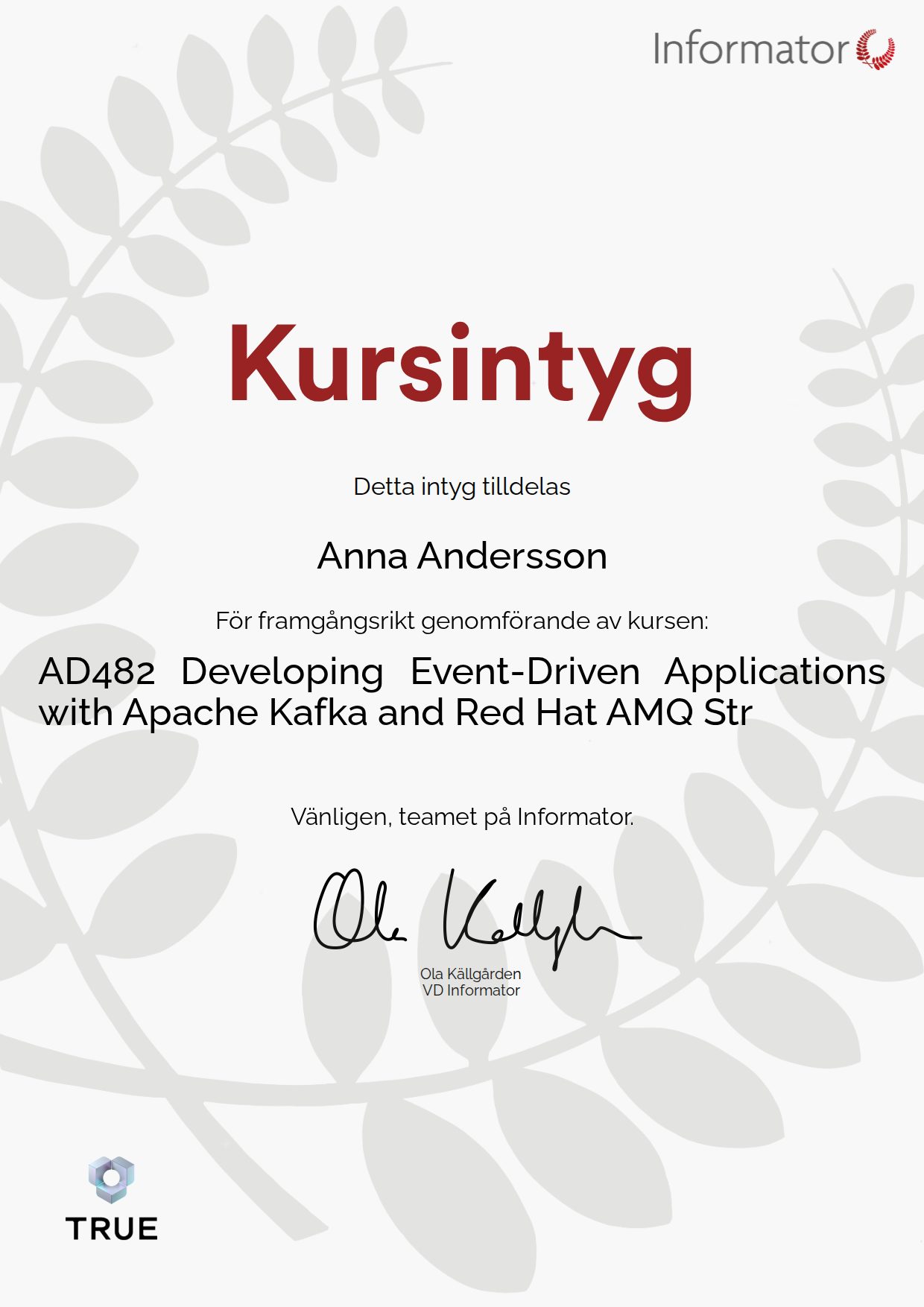
When you complete the course, Informator Utbildning issues your certificate. Your name, the course content and the issue date are encrypted and secured on blockchain, so it cannot be changed, and anyone can check that it is genuine.

100% Verifiable certificates Secured on blockchain

Sample Credential with placeholder data. Each credential is issued with the recipient’s details and is verifiable with the provider.