AI and Cybersecurity is an advanced course from Örebro University's Smarter programme that explores where artificial intelligence meets cyber-defence. You will see how AI is used both to protect digital systems - for example fingerprint recognition for authenticating legitimate users - and to attack them, such as fuzzing techniques that crash vulnerable targets. The course gives working professionals the tools to enhance, evaluate and challenge the security of modern systems with AI. It is given in English at distance with a few mandatory meetings on campus.
Duration: 3 months
Format: Hybrid
Location: Örebro
Language: Swedish, English
Level: Advanced
Time commitment: about 80 hours over one semester, part time (25%); distance with mandatory on-site meetings
Request info
Want to know more before you sign up?
Send a short question and we will forward it directly to the provider.
We forward your question to Örebro universitet. No spam, no third parties.
About the course.
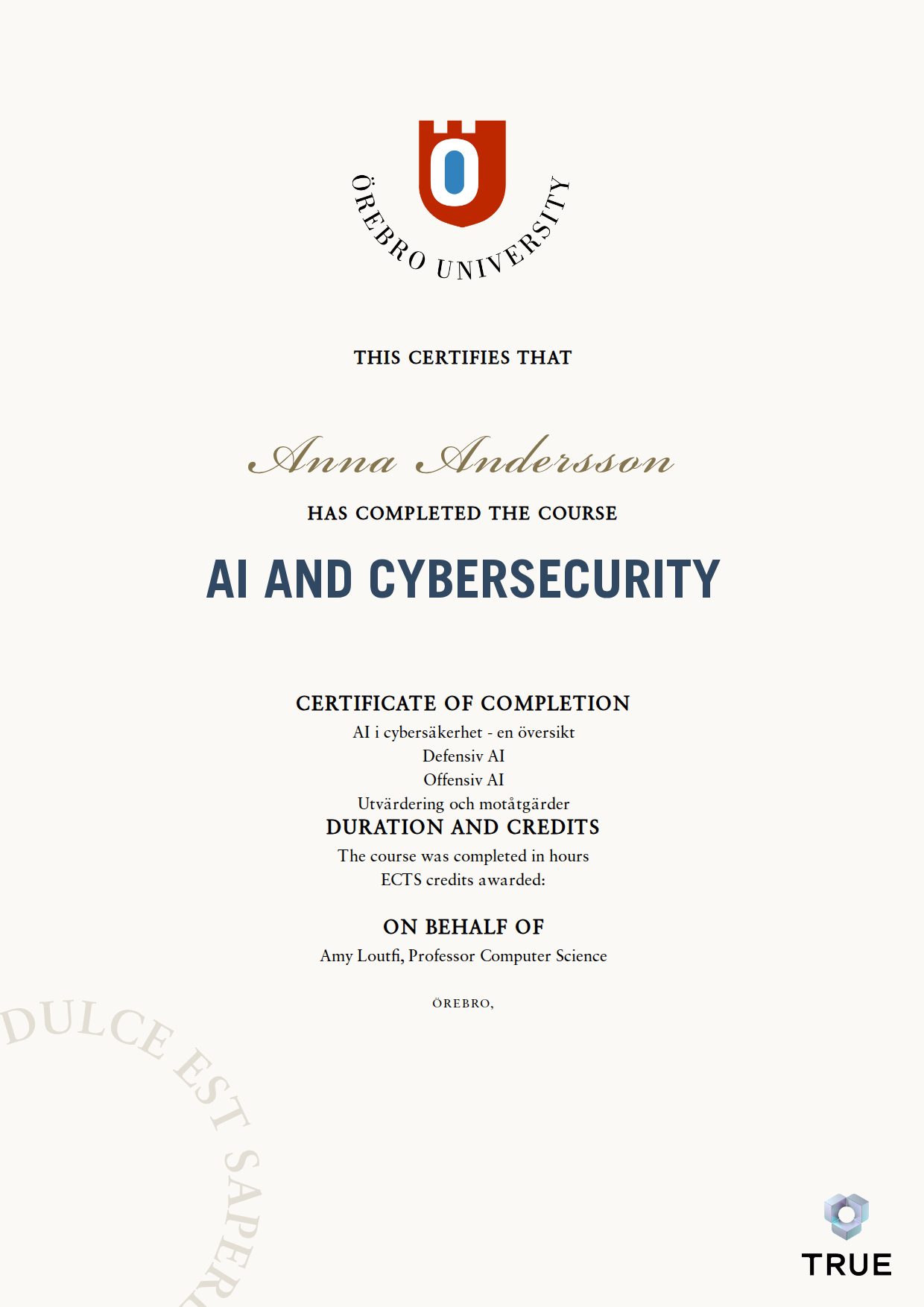
This certifies that the participant has developed knowledge of how AI technologies intersect with cybersecurity. The participant understands both defensive and offensive applications and can apply AI to enhance, evaluate, or challenge digital security systems.
This certifies that the participant has developed knowledge of how AI technologies intersect with cybersecurity. The participant understands both defensive and offensive applications and can apply AI to enhance, evaluate, or challenge digital security systems.
What you will learn
What you learn.
You can explain how AI is used both defensively and offensively in cybersecurity.
You can apply AI-based methods for authentication, for example biometric recognition.
You can describe and reason about AI-driven attacks such as fuzzing against vulnerable systems.
You can evaluate how AI can both strengthen and undermine a system's security.
You can critically assess risks when AI is introduced into security-critical digital systems.
Curriculum
How the course is built.
AI in cybersecurity: an overview
How AI is changing both defence and attack in digital systems.
Defensive AI
AI-based authentication and recognition, e.g. fingerprint and biometric identification of legitimate users.
Offensive AI
AI-assisted attacks such as fuzzing to find and exploit vulnerabilities.
Evaluation and countermeasures
Assessing and strengthening security in systems where AI is used by both sides.
Target audience
Who is this for?
For working engineers, developers and security specialists who want to understand how AI affects both defence and attack in cybersecurity. Prerequisites: 180 credits including 15 credits of programming, plus English 5/English A.
What "verified" means here
Verified credential.
When you complete the course, Örebro universitet issues your certificate. Your name, the course content and the issue date are encrypted and secured on blockchain, so it cannot be changed, and anyone can check that it is genuine.
Dozens of credentials issued 100% Verifiable certificates Secured on blockchain