Request info
Want to know more before you sign up?
Send a short question and we will forward it directly to the provider.
We forward your question to Campus Nyköping. No spam, no third parties.
Send a short question and we will forward it directly to the provider.
We forward your question to Campus Nyköping. No spam, no third parties.
After completing the programme, the student should have knowledge of/in The student should gain: - knowledge of statutes, guidelines and documentation in the social pedagogical field of work, - knowledge of mental ill-health such as mental health problems, mental illness, mental syndromes and neuropsychiatric disabilities, as well as addiction and co-morbidity, - knowledge of human development, socialisation and living conditions, and the connection between the environment people grow up in and social exclusion, - knowledge of sociological and psychological, social psychological, intersectional and intercultural perspectives in social pedagogical work, - knowledge of the path to a norm-breaking lifestyle and of work to promote the conditions for leaving such a lifestyle, - knowledge of health perspectives and health-promoting ways of working, - knowledge of chains of care in social work and of cooperation and coordination between different actors in the social pedagogical field of work and adjacent fields of work, - knowledge of the relationship of their own professional role to adjacent professions in social work, - specialised knowledge of the basic perspectives of social pedagogy, its development and its relation to different theories and theoretical perspectives in the field, - specialised knowledge of methods in social pedagogical work, generic and specific, in social care and treatment work and everyday support, and - specialised knowledge of communication, communication processes, conversation methodology and models for conflict management. After completing the programme, the student should have skills in The student should gain skills in: - identifying resources and interventions for effective social pedagogical work, based on an understanding of how social problems arise, how they are expressed and what their consequences are, - working with a person-centred approach and treating people with respect regardless of sex, transgender identity or expression, ethnicity, religion or other belief, disability, sexual orientation or age, - working in accordance with applicable statutes in social pedagogical work, - reflecting on the knowledge base for interventions in different parts of the social pedagogical field of work aimed at different target groups, - working in and collaborating with interprofessional teams, - using social pedagogical methods and collaborating in collegial teams, - taking part in social pedagogical interventions in cases of co-morbidity among people with mental ill-health and addiction, - contributing to a safe and secure care and treatment environment and to systematic quality work, - contributing to critical review of the organisation and continuously focusing on possible development of the organisation and its methods, and - communicating social pedagogy, theoretical perspectives and considerations about interventions related to perceived needs in a foreign language. After completing the programme, the student should have competences to The student should gain competences to: - work with a high level of professionalism and good professional ethics in different social pedagogical fields of work, - work with mobilising social pedagogical work in different contexts, - work in interprofessional teams and carry out their assignment from a holistic and care chain perspective through cooperation and coordination, - independently, professionally and ethically, within the scope of their assignment, plan, carry out, document, evaluate and follow up social pedagogical interventions and methods in the various arenas of the field, - based on a professional approach, carry out social pedagogical work aimed at different target groups and independently assess the evidence for different interventions and which social pedagogical intervention is appropriate in specific situations, based on evidence-based practice, and - handle different situations in the field with a high level of readiness to act, be an active party in competence and organisational development, and act independently in the tasks of the professional role in a way that creates quality and leads to further learning and professional development. To see which parts have been completed, see the certificate of education.
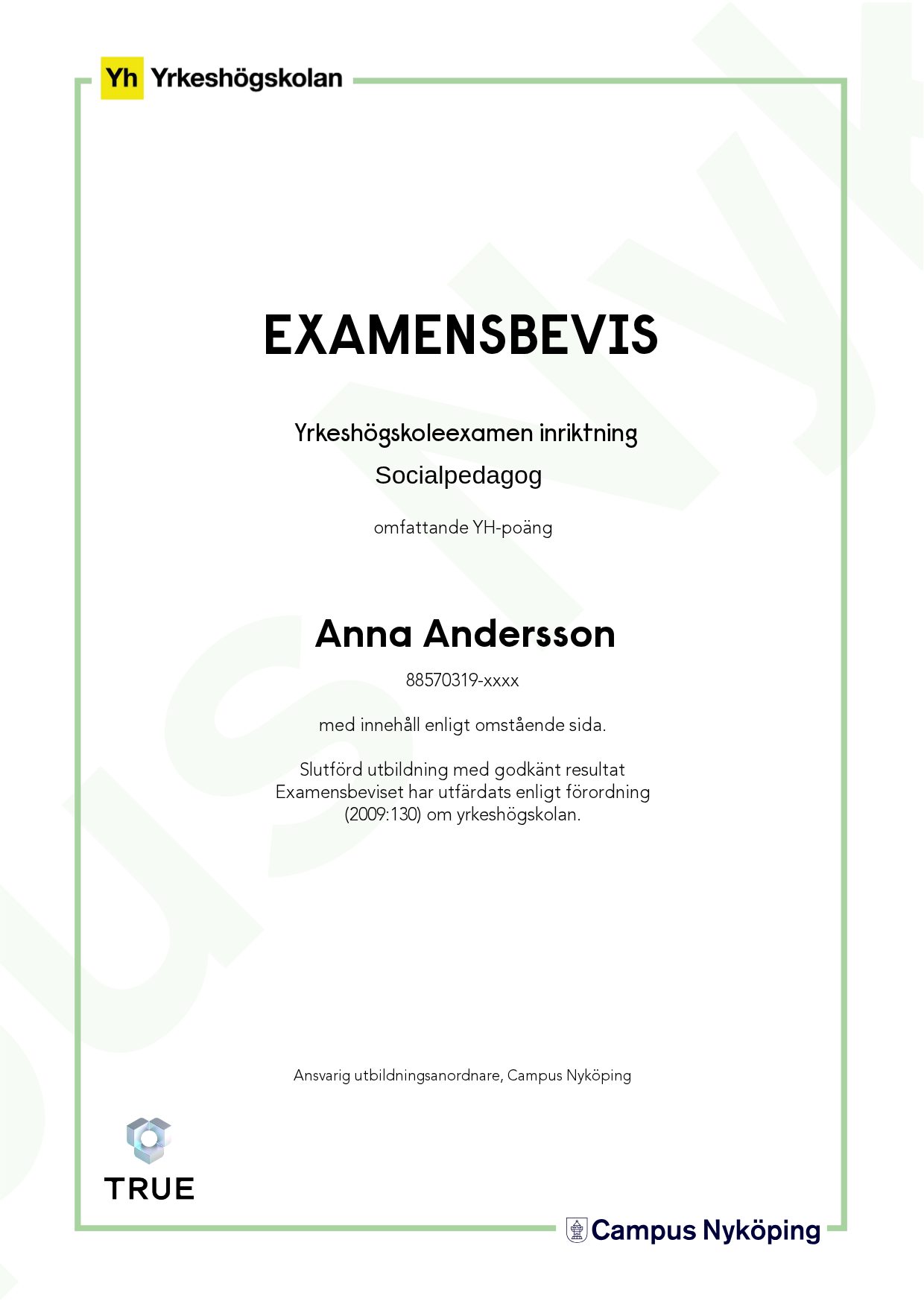
When you complete the course, Campus Nyköping issues your certificate. Your name, the course content and the issue date are encrypted and secured on blockchain, so it cannot be changed, and anyone can check that it is genuine.
Sample Credential with placeholder data. Each credential is issued with the recipient’s details and is verifiable with the provider.